7P Framework
← Stories
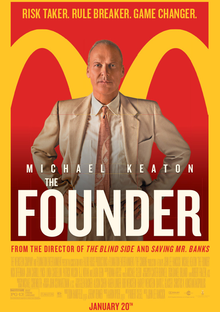
Poster for The Founder (2016)

Product · also: Profits

The Founder

Directed by John Lee Hancock

Film · 2016 · 1h 55m

Starring Michael Keaton, Nick Offerman, John Carroll Lynch, Laura Dern.

Find streaming options ↗

You're not in the burger business, Ray. You're in the real-estate business.
Harry Sonneborn (B.J. Novak), The Founder (2016)

Pairing

Why this story, in this stage

The Founder is paired with the Product stage — build the right thing first; then build it right. A mixed lesson. It also speaks to Profits.

The argument

Central thesis

Ray Kroc didn't invent McDonald's. He met the McDonald brothers, watched their kitchen-as-factory operation in San Bernardino, and recognized that the real business wasn't food — it was the system that produced food at scale and consistency. The brothers built that system. Kroc franchised it. Then he took it from them.

The film's structural genius is the Sonneborn scene. Kroc is bleeding cash. Franchisees are buying burgers cheap; the margin on supply doesn't cover the office. Sonneborn looks at the numbers and tells Kroc he's been thinking about the wrong product. You're not in the burger business, Ray. You're in the real-estate business. The corporation owns the land under each franchise; the franchisees pay rent. The economic engine is real estate, not hamburgers. From that moment, every decision Kroc makes is on solid ground — and the McDonald brothers are doomed.

For founders, the film carries two lessons in tension. Find the hidden business model that the obvious business obscures — that's the real-estate insight, transferable. AND the discipline of finding that insight can corrode the relationships that built the original product. Mac and Dick get screwed. The system they built outlives them. The film doesn't take a side on whether that's tragedy or capitalism.

The hook

The founder lesson

Most companies are not in the business they think they're in. Finding the hidden business model is the founder's deepest work — and the most expensive insight.

Three founder lessons.

First, the real-estate insight, generalized. Almost every successful company eventually discovers it's not in the business it thought. Amazon thought it was a bookstore; it's a logistics network. Stripe thought it was payments; it's a developer platform. McDonald's thought it was burgers; it's land. The insight is downstream of running the business honestly long enough to see what's actually paying you. Founders who don't look for it get stuck in the original framing. Founders who look for it find new ground to scale on.

Second, the relationships. Kroc's pattern — the gradual erosion of trust with the brothers, the broken handshake on a 1% royalty, the renaming of "Kroc's first store" — is the founder shadow side. The discipline that finds the real-estate insight is the same discipline that lets you sleep when you've taken something from someone who built it. Both lessons are in the same film, told without a thumb on the scale. Founders who admire Kroc's eye for the model should also reckon with the cost; the film insists on both.

Third, the persistence speech. Kroc recites the Calvin Coolidge "Nothing in this world can take the place of persistence" speech in a hotel room as motivation. The film holds the camera on him long enough that it becomes uncomfortable — is this inspiration, or is this self-justification for what he's about to do? The film argues both. Founders should watch this speech with the discomfort intact: persistence as virtue and persistence as cover are the same posture from inside the head of the person doing it. Knowing which one you're in is the work.

5 takeaways

What to remember

  • The system *is* the product

    The McDonald brothers' choreographed kitchen — drawn in chalk on a tennis court — is the actual invention. Founder analog: build the factory before you scale. Most early-stage companies skip the factory and try to scale the artisanal output; the brothers showed why that doesn't work.

  • The hidden business model

    Kroc was selling burgers; the company was earning rent. *Founder analog: ask, every quarter, what is the data telling us we're actually in the business of?*** The original framing rarely survives twenty-four months of honest operation. The hidden model is where the next decade lives.

  • Verbal agreements aren't protection

    Kroc and the brothers agree on a 1% royalty over a handshake. It's never paid. Founder analog: every agreement that matters at year five must be in writing at year one. The handshake works until the money is real; then it doesn't.

  • The 1% — the founder's shadow side

    Kroc takes the company. The brothers take a buyout that's smaller than what the franchise would have paid them annually. Founder analog: the discipline that finds the hidden business model is the same discipline that lets you sleep through the cost. Knowing which side of the line you're on is the work.

  • "I'm a winner" — the persistence speech

    Kroc recites the Coolidge quote in a hotel mirror. Founder analog: persistence-as-virtue and persistence-as-cover-for-cruelty are the same posture from the inside. Watch this scene with the discomfort intact. Re-watch your own decisions with the same posture.

Practice CardOne-screen exercise

What business are you actually in?

Take a clean sheet of paper. Write: 'I think we are in the [X] business.' Then write three things that have to be true for that to be the right framing.

Now look at your last twelve months of revenue, time, and customer behavior. What's the business that the data is telling you you're actually in?

Often it's adjacent: not B2B SaaS, but data infrastructure. Not coaching, but community. Not consulting, but a productized methodology. Not a bookstore, but logistics. Not burgers, but land.

Sit with the gap. The work isn't to abandon the original framing; it's to see it. Some companies are exactly what they think they are. Most aren't.

The McDonald brothers never asked this question. Kroc did. The asymmetry of that one question — over thirty years — was the whole company.

Re-run this quarterly.

Share with a founder who's deciding whether to keep going.