7P Framework
← Stories
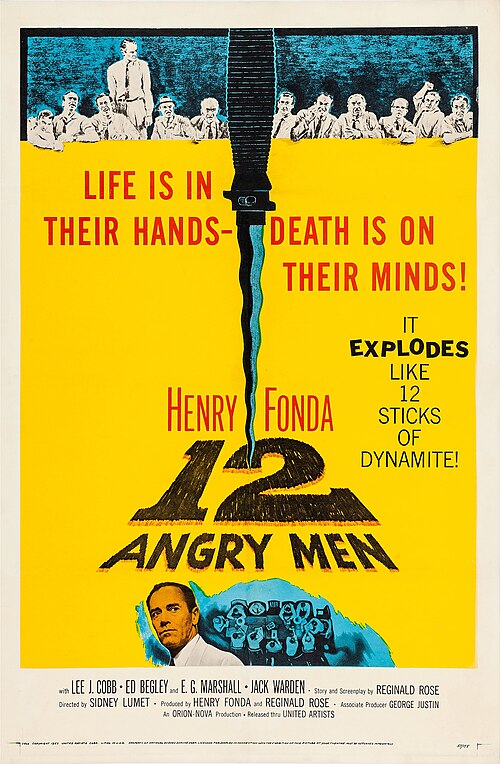
Poster for 12 Angry Men (1957)

People · also: Prove

12 Angry Men

Directed by Sidney Lumet

Film · 1957 · 1h 36m

Starring Henry Fonda, Lee J. Cobb, E.G. Marshall.

Find streaming options ↗

It's always difficult to keep personal prejudice out of a thing like this. And wherever you run into it, prejudice always obscures the truth.
Juror #8 (Henry Fonda), 12 Angry Men (1957)

Pairing

Why this story, in this stage

12 Angry Men is paired with the People stage — who builds it with you determines whether it gets built at all. A model. It also speaks to Prove.

The argument

Central thesis

The film takes place in a single jury room over the course of one afternoon. Eleven jurors are ready to send a young man to the electric chair on a routine vote. Juror #8 (Henry Fonda) raises his hand alone for not guilty — not because he believes the boy is innocent, but because he has reasonable doubt. Over the next ninety minutes, he doesn't argue or pressure — he asks. Each juror's guilty reveals itself, under questioning, to be something other than evidence: a grudge against a son, a stereotype about kids from the slums, a missed Yankees game.

The film is a masterclass in changing a room without bullying it. Fonda doesn't speechify; he holds open a possibility. He asks for the knife to be examined. He times the old man's walk to the door. He waits. By the end, the question isn't whether the boy is guilty — it's how confidently the room can claim the answer.

For founders defending a contrarian view in a board meeting, in a co-founder argument, in a town hall where everyone has already decided — this is the only film that makes the technique visible.

The hook

The founder lesson

Changing a room of eleven without bullying it is a craft. 12 Angry Men is the only film that makes the technique visible.

Founders are constantly in rooms where the consensus has already formed. The board has already decided to fire someone. The team has already decided the strategy. The investors have already decided the market is too small. You're the only no. The instinct is to argue louder. The film's lesson: argue more carefully.

First, ask questions, don't make claims. Juror #8 never declares the boy innocent. He asks: is the knife unique? Could the old man have walked that distance in fifteen seconds? Why was the woman not wearing her glasses? Every question opens a door the room had assumed was closed. Founders who argue invite counter-argument; founders who ask invite the room to examine its own reasons.

Second, slow the timeline. The first juror to call for a quick vote is the one most invested in the verdict already being decided. Fonda's first move is to ask for an hour of discussion before re-voting. Founders who allow the room's pace to dictate their own decision-making lose by default. The contrarian view almost always needs more time than the meeting allows.

Third, surface the prejudice without accusing it. Each juror's guilty turns out, under patient questioning, to be a vote on something other than the evidence — a grudge, a stereotype, a missed game. Fonda doesn't accuse them; he creates a space in which each one examines his own reasons. That's the work of leadership in any contested room: not to defeat the others' reasons, but to surface them. When a juror sees that his own guilty was about his absent son and not the boy, the vote changes itself.

5 takeaways

What to remember

  • Standing alone is the precondition, not the strategy

    Fonda raises his hand alone. He doesn't have a plan; he has a doubt. *Founder analog: the contrarian's first move is to be willing to be the only no — without yet knowing how to win.* The willingness creates the space in which technique can land.

  • Evidence beats rhetoric

    Fonda buys an identical knife and stabs it into the table. He doesn't tell them the prosecution's case is wrong; he shows them. *Founder analog: when the room's belief is built on assumption, find the exact counter-evidence and bring it into the meeting. Show the data, don't argue the data.*

  • Patience as method, not virtue

    Fonda times the old man's walk across the jury room with a stopwatch. *Founder analog: if a claim depends on a number, measure the number — don't dispute it abstractly.* Most contrarian wins arrive when the contrarian is the only person who actually checked.

  • Surface the real reasons

    One juror is voting guilty because he wants to make the Yankees game. Another because his own son walked out on him. *Founder analog: when the room's logic doesn't add up, the real reason isn't logical — it's something else.* Don't defeat the stated reason; create the space for the actual reason to be named.

  • The slow turn — 11 to 1, 10 to 2, eventually 0 to 12

    Not a flip; a sequence of individual changes of mind. *Founder analog: don't try to convince the room. Convince one person who can then talk to the next person.* The room turns when individuals turn, in sequence, on their own time.

Practice CardOne-screen exercise

Hold the room without bullying it.

Pick a recent meeting where you held the contrarian view and lost it. Re-run it on paper: what did you ARGUE, and what could you have ASKED instead?

'I think we shouldn't fire him' becomes 'What specifically did he do — and what would success look like in 90 days if we kept him?'

'I think this market is bigger than that' becomes 'If we were wrong about the market size, what evidence would we expect to see in the next quarter?'

'I think the strategy is wrong' becomes 'Walk me through the assumption that has to hold for this to work — and what would tell us it doesn't?'

Argue less. Ask more. Slow the timeline. Test the evidence. The slow turn isn't a single move; it's a sequence of individual changes of mind, made when each person is given space to examine their own reasons.

Re-do this exercise after the next contested meeting. The skill compounds.

Share with a founder who's deciding whether to keep going.