7P Framework
← Stories
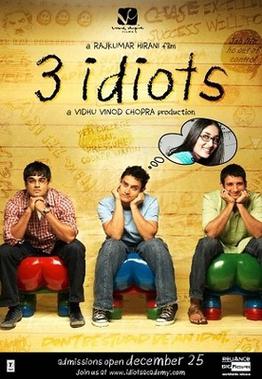
Poster for 3 Idiots (2009)

Purpose · also: People

3 Idiots

Directed by Rajkumar Hirani

Film · 2009 · 2h 50m

Starring Aamir Khan, R. Madhavan, Sharman Joshi, Kareena Kapoor.

Find streaming options ↗

Strive for excellence, and success will come chasing you, pants down.
Rancho, 3 Idiots (2009)

Pairing

Why this story, in this stage

3 Idiots is paired with the Purpose stage — the reason you start, and the reason you survive. A model. It also speaks to People.

The argument

Central thesis

3 Idiots is a Bollywood comedy that delivers an unexpectedly serious lesson about purpose. Rancho — Aamir Khan's character — refuses to study for grades; he studies because he loves machines. Farhan is forced into engineering by his father when his real love is wildlife photography. Raju is paralyzed by his family's economic anxiety — they need him to land a high-paying engineering job to lift them out of poverty.

The film's tragic foil is Joy Lobo, the brilliant student whose passion project is crushed by the rigid director (Virus). Joy hangs himself. The film never lets the audience forget that the conformity machine has casualties — and that the casualties aren't always the people who quit. Sometimes they're the people who stay and disappear quietly.

For founders globally — especially those from cultures where the path is be a doctor or engineer at a big firm (much of Asia, the Middle East, parts of Europe) — the question 3 Idiots asks is the founder's first question: what do you want, vs. what does everyone else want for you? The film's answer is patient. It doesn't tell Farhan to drop out in act one. It lets him find his way through, have the conversation with his father, and accept the cost of disappointing the people who raised him with one path in mind. Founders who skip this conversation carry the unfinished business into every decision they make later.

The hook

The founder lesson

The founder's first decision isn't what to build. It's whose definition of success you're using.

Three specific founder lessons.

First, the friend group is a co-founder team in disguise. Rancho, Farhan, and Raju are the three idiots — but the film's structural genius is that they hold each other together through everything. Raju's father's stroke. Farhan's photography ambition. Rancho's identity mystery. Each crisis is held by the other two. Founders without a Rancho-Farhan-Raju trio rarely make it to year three. The lesson rhymes with Hidden Figures: peer support is structural, not optional.

Second, the cost of conformity, named through a death. Joy Lobo's suicide is the film's quiet hinge. The system that crushes Joy's project is the same system that pressures Raju into a near-suicide attempt later. Conformity has casualties. For founders deciding whether to take the safer corporate job or build the thing they actually believe in, the film argues: the price of the safer path is real, and not always paid by you alone — sometimes it's paid by the version of yourself that doesn't get to be born.

Third, "pursue excellence, success will follow" is the founder lesson dressed as a comedy line. Rancho's discipline isn't to target success; it's to target the work that makes success a downstream effect. Founders who optimize for revenue often build things nobody loves. Founders who optimize for the work the founder would do for free build things that compound. The market eventually finds excellent things. It takes longer than the marketers say.

5 takeaways

What to remember

  • The three friends are a co-founder team in disguise

    Each crisis is held by the other two. Founder analog: peer support is structural, not optional. A trio of founders three months ahead, parallel, and three months behind makes year three possible. Going solo rarely does.

  • Farhan's photography — choose the work you love

    Farhan is good at engineering and great at photography; the film argues that good at is not enough when great at is available. Founder analog: the work you'd do without a paycheck is the work that compounds — the rest is rent.

  • Conformity has casualties

    Joy Lobo's suicide is the film's quiet hinge. Founder analog: the cost of the safer path is real and not always paid by you alone — sometimes it's paid by the version of yourself that doesn't get to be born. Don't underprice that cost in the calculation.

  • "Aal izz well"

    The mantra reads as chipper denial; on second read it's a deliberate cognitive technique — naming a feeling forward to make space for action despite it. Founders use the same mechanism without the name. Use the name; the discipline lands faster when you call it what it is.

  • Pursue excellence; success follows

    Rancho's discipline isn't to target success — it's to target the work that makes success a downstream effect. Founder analog: optimize for the work, not the metric. The market eventually finds excellent things. It takes longer than the marketers say.

Practice CardOne-screen exercise

Whose definition are you using?

Take fifteen minutes. Write down your current definition of success — the one you actually use in private, not the one you'd put on a deck.

Now write down where it came from: a parent's expectation, your school's prestige metric, your industry's salary band, an investor's framework, a peer comparison.

Cross out everything that isn't yours.

What's left is the definition that will hold at 3 AM. If nothing's left, write a new one — in your own words, in the present tense, with the exact specificity Rancho would demand. Re-read it weekly until it's true.

If you find yourself defending a definition you crossed out, that's data: you haven't fully claimed your own answer yet. Farhan and Raju took the whole film to claim theirs. Most founders take longer.

Share with a founder who's deciding whether to keep going.