7P Framework
← Stories
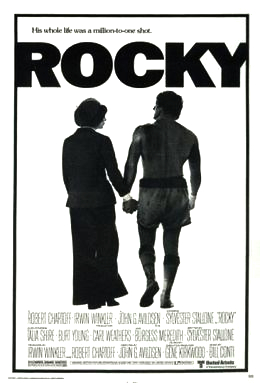
Poster for Rocky (1976)

Purpose · also: Persistence

Rocky

Directed by John G. Avildsen · written by Sylvester Stallone

Film · 1976 · 1h 59m

Starring Sylvester Stallone, Talia Shire, Burgess Meredith, Burt Young.

Find streaming options ↗

I just wanna go the distance. Nobody's ever gone the distance with Creed. And if I can go that distance, see, and that bell rings and I'm still standin', I'm gonna know for the first time in my life that I weren't just another bum from the neighborhood.
Rocky Balboa, Rocky (1976)

Pairing

Why this story, in this stage

Rocky is paired with the Purpose stage — the reason you start, and the reason you survive. A model. It also speaks to Persistence.

The argument

Central thesis

Rocky doesn't need to win the fight to win his life. The film's discipline is to make the attempt the substance — Rocky's purpose is to last the full fifteen rounds, not to take the title. Going the distance is a vocational answer to the existential question of why you do anything difficult.

The genius of the screenplay is that it earns this distinction the hard way. Apollo Creed picks Rocky as a bicentennial publicity stunt — a chance for a southpaw nobody from Philly to take a swing at the champ. By every conventional metric, Rocky is going to lose, and badly. The film knows this. Rocky knows this. The training montages, the early-morning roadwork, the meat locker, the steps of the Philadelphia Museum of Art — none of them are about winning the fight. They're about being someone who showed up worth fighting.

When the bell finally rings on the fifteenth round and Rocky is still standing, he wins his life regardless of the scorecard. That's the move every founder needs the language for.

The hook

The founder lesson

Most founders quit because they confuse failing-to-win with failing-to-matter. Rocky names the difference.

First-time founders measure themselves against exits, Series A rounds, launch-day metrics. The market is the only judge that matters — Prove says so* — but the market is a downstream judge, and you have to last long enough to be judged. Rocky is a film about how to last that long without lying to yourself about what counts.

The disciplines are concrete. Rocky's training shows up before motivation does — 5 AM, raw eggs, the cold, the body running on something that isn't enthusiasm. That's the founder's first lesson: the work of building has to survive the days you don't feel like building, or it doesn't survive at all.

Mickey, the trainer (Burgess Meredith), is the second lesson. He sees Rocky before Rocky sees himself. "You got heart, but you fight like a goddamn ape!" That's a mentor doing real work — telling you the truth you can't tell yourself yet. Every founder needs a Mickey. The Mentors surface on this site exists because of this.

Adrian (Talia Shire) is the third. "Yo, Adrian!" — the line so over-quoted it has become a meme. But the film's love story is not sentimental decoration; it's structural. The work that asks you to take Apollo's punches for fifteen rounds requires somewhere to come home that isn't the work. Founders who lose this lose the whole thing — usually after the fight, when there's nothing left to come down to.

The last lesson is the bell. The fight ends because the bell rings, not because anyone won — and that's true of every founder season too. The market verdict comes whenever it comes. Until then, you train, you take the rounds, you stay standing. Going the distance is the answer to the question "why am I still doing this?" when winning isn't.

5 takeaways

What to remember

  • Discipline shows up before motivation does

    The 5 AM roadwork, the raw eggs, the meat locker — Rocky's training scenes work because they happen on days when nothing else is working. Founder analog: build your daily practice for the bad days, not the good ones. A discipline that depends on motivation is a discipline you'll lose.

  • Going the distance ≠ winning

    Rocky's purpose is to last fifteen rounds, not to take the belt. *Founder analog: define a finish line that's about you finishing, not the market voting yes.* Customer interviews completed. Compass pulses logged. Months survived without the wrong hire. The metrics that prove you stayed in.

  • Mickey is the mentor who tells you the truth you can't tell yourself

    Burgess Meredith's "You got heart, but you fight like a goddamn ape" is what real mentorship sounds like. Not encouragement — correction with affection. Founders who don't have a Mickey don't see what's actually wrong; they only see what's frustrating.

  • Adrian is structural, not sentimental

    "Yo Adrian" is a meme; it's also the film's deepest founder lesson. The work of taking the punches requires somewhere to come home that isn't the work. Founders who lose Adrian lose the whole thing — usually after the fight is over, when there's nothing left to come back down to.

  • The bell rings on its own time

    Rocky doesn't decide when the fight ends — the bell does. Founder analog: the market judges when the market judges. Until then, you don't get to call it. The discipline is to stay standing through rounds you didn't choose to take.

Practice CardOne-screen exercise

Define your fifteen rounds.

Most founders measure themselves against winning — a Series A, a launch metric, an exit. Rocky's discipline is to define a separate finish line, one that's about staying in regardless of the scorecard.

Take ten minutes and write down one number, one date, one outcome that proves you went the distance — independent of winning. Examples:

"I will complete 90 customer conversations in six months. Whether anyone signs up doesn't decide whether I finished."

"I will post a Knot every week for a year. The Cruxes I get back don't decide whether I showed up."

"I will run twelve months of the company without making a wrong hire. The hire I do make doesn't decide whether I held the line."

The finish line should be falsifiable, modest, and entirely about your conduct, not the market's verdict. Pin it somewhere visible. Re-read on the days when winning feels far away.

That's your fifteen rounds.

Share with a founder who's deciding whether to keep going.